Remembering the Santa Cruz Massacre

12 November 2011

To mark the 20th anniversary of the infamous Santa Cruz Massacre, we present here a guide to recent commentary and some archival resources on this landmark event.
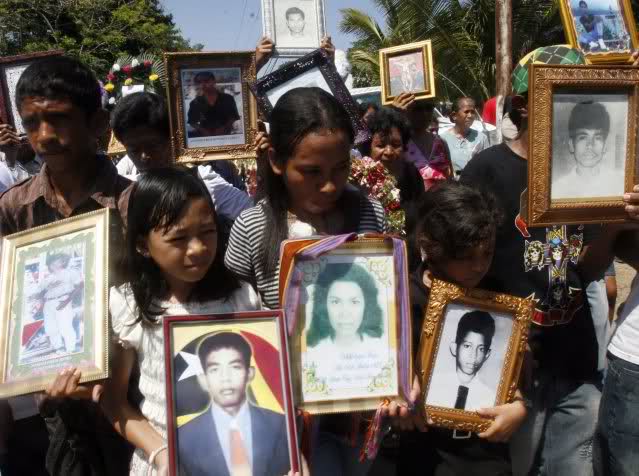
Relatives hold photos of Santa Cruz massacre victims during a commemoration in Dili, 12 November 2009. (1)

The shooting by Indonesian troops of an unknown number of unarmed Timorese demonstrators at the Santa Cruz cemetery in Dili on 12 November 1991 was a watershed event in East Timor’s modern history.

While other massacres and much larger losses of life occurred in earlier years of Indonesian rule, the Santa Cruz Massacre became the iconic representation of the military occupation of East Timor.

The essential difference between this event and earlier crimes was that it was witnessed and recorded by independent (ie non-Timorese and non-Indonesian) reporters and other observers.

The impact of this event on East Timor’s future was decisive. In the words of former Indonesian foreign Minister Alatas, thereafter “international support for Indonesia’s position inexorably declined while that for the independence movement in East Timor markedly increased”. (2)

Long-term preservation of the documentary source materials is crucial to retaining for future generations a detailed knowledge and understanding of this event. Some of these documents may also serve justice if the perpetrators of the crimes on this day in 1991 ever face a proper and fair trial.

——————–

Centro Audiovisual Max Stahl – Timor-Leste (CAMS-TL)
British film maker Max Stahl’s dramatic video footage of the massacre was crucial to international knowledge of the event. Copies of the original footage and productions including key scenes are held at CAMS-TL in Dili.

The French National Audiovisual Institute (INA) houses copies of some Max Stahl Timor footage. INA provides sample sequences for viewing online – including the original Santa Cruz footage and subsequent interviews with survivors.

Some Stahl footage can be found on YouTube, including this low resolution sequence.

CHART recently published a guide to CAMS-TL video footage, including the 1991 material and a transcript of some massacre footage.

Resistance Archive & Museum (AMRT)
AMRT provides online access to vast numbers of digitised documents, including Santa Cruz material.

The 20th anniversary is commemorated by AMRT with a special website presentation which also includes a link to a catalogue search result on the term “Santa Cruz”.

Commission for Reception, Truth & Reconciliation (CAVR)
The library and archives of Timor’s CAVR (now managed by a Post-CAVR Secretariat) hold original records on Santa Cruz, including eye-witness accounts. An account of the event and a guide to sources can be found in CAVR’s monumental 2005 report Chega!. See especially Chapter 3 (p.115ff) and Chapter 7 (p.199ff).

ACFOA Human Rights Office
The Human Rights office of the Australian Council for Overseas Aid (now ACFID), headed by Pat Walsh, collected extensive materials on Santa Cruz during the course of its long-standing advocacy work for East Timorese justice and self-determination. CHART produces here for the first time a guide to the content of these files.

This collection of material remains in private hands but under CHART custody where it will be the focus of an extensive digitisation program in 2012 for easy access in Timor-Leste and elsewhere.

East Timor and Indonesia Action Network (ETAN)
ETAN began in the USA in response to the Santa Cruz massacre and soon became a key reference point for international East Timor activism and advocacy.

ETAN marked the 20th anniversary with a feature page on the event and maintains a guide to Santa Cruz information and ongoing calls for justice on the matter.

Clinton Fernandes
Prominent Timor researcher and justice advocate Clinton Fernandes’ web-based Companion to East Timor includes some sample documents and a summary of Santa Cruz.

Jill Jolliffe
Microfiche copies of some Santa Cruz material may be found in Jill Jolliffe’s archival collection. See pages 35-36 of the guide to her collection – The East Timor Question, 1975-1996.

The Jolliffe collection is held by a number of academic and major libraries in Australia and elsewhere.

National Archives of Australia (NAA)
NAA holds large volumes of material on East Timor. However access to its holdings are generally covered by a standard ‘closed period‘ of twenty to thirty years after the events documented. Santa Cruz files will not be open for access until 2016-17.

Indonesia?
With the exception of documentary fragments held in collections outside Indonesia, we have no knowledge of accessible official or unofficial Santa Cruz records in Indonesia.

Other sources and commentary?
Here is a list of other instances,  from disparate sources, of online Santa Cruz materials and commemorations of the 20th anniversary. More to be listed in coming days.

Forensic studies report (2010) by Soren Blau & Luis Fondbrider

Amnesty International Statement (2011-11-12)

Historical Justice & Memory Research Network

La’o Hamutuk reflection (2011-11-12)

VivaNews.com (Indonesian)

TSF Radio Noticias (Portugal) – includes some great still images of Santa Cruz events.

Sapo Noticias Timor-Leste  (Portuguese language feature)

CAN YOU HELP?
If you know of other significant archival collections with Santa Cruz content, please advise us and we will add them to this guide.

Sources:

(1) Martine Perret / UNMIT, 2008. See online source.

(2) Ali Alatas. The pebble in the shoe: the diplomatic struggle for East Timor. Aksara Karunia, Jakarta, 2006, p.64.


Max Stahl Video Archive: Holdings listed

31 October 2011

CHART is pleased to publish here the first comprehensive listings of the collection of the Centro Audiovisual Max Stahl Timor-Leste (CAMSTL) in Dili. These listings were created by CHART from CAMSTL data provided by the Centre’s founder, Max Stahl.

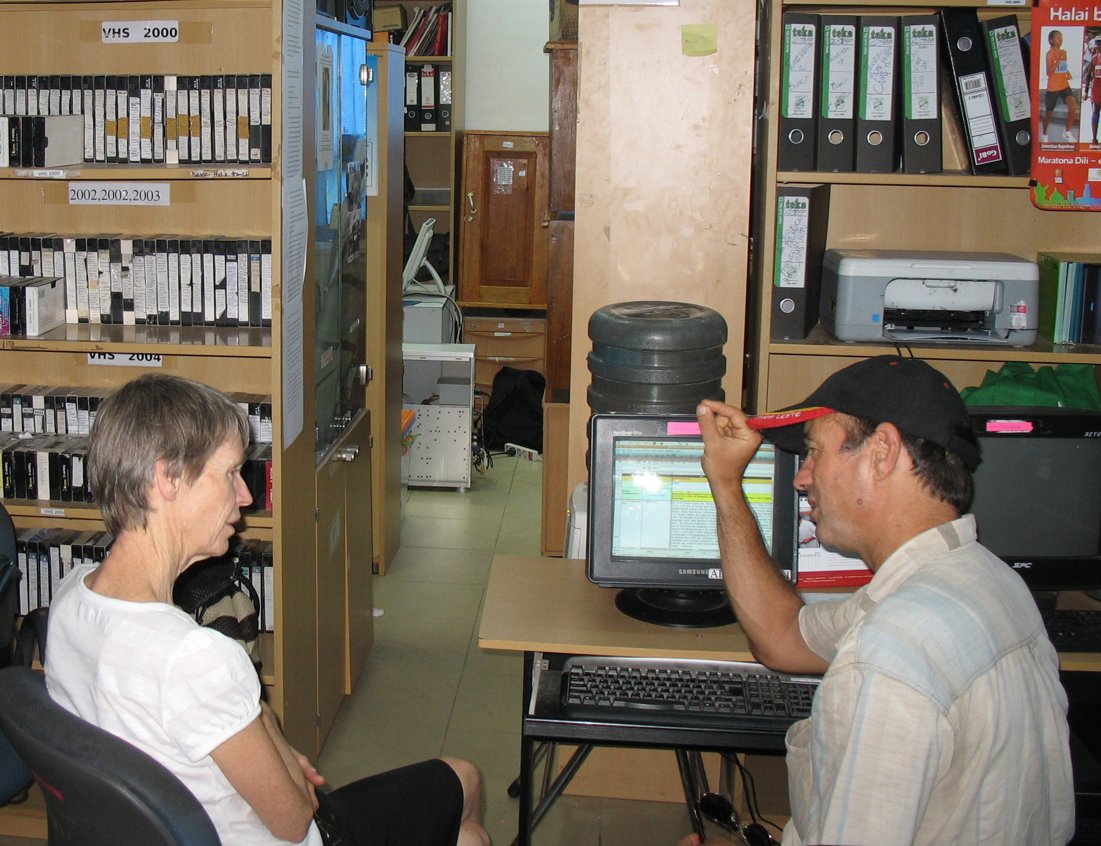
Max Stahl explains archive program to CHART's Cecily Gilbert, July 2011

Max Stahl needs no introduction. His stunning footage of the 1991 Santa Cruz massacre in Dili played a central role in strongly increasing international opinion against the Indonesian military occupation of East Timor.

Less well-known is the extensive holdings of the video archive Max has established in Timor-Leste over the past decade – the Centro Audiovisual Max Stahl Timor-Leste (CAMSTL).

Today’s events, tomorrow’s archives
Stahl’s 1990s raw footage and production pieces on military occupation and resistance are only part of the total collection at now at CAMSTL. He and a team of East Timorese are creating an audiovisual record of the first years of newly independent Timor-Leste. The archive holds significant footage on developments in the territory while under United Nations administration until 2002. Since then, a large amount of material has been recorded – covering historical interviews and present day economic, social, political and other institutional events and developments in Timor-Leste.

In addition to filming these subjects, the CAMSTL team has developed hundreds of detailed summaries and transcripts of the material and a growing number of formal production titles in local languages. Such material will prove invaluable to future generations of East Timorese, including its educators and historians to come.

Footage Lists
Raw video footage lists are presented here by year of video creation. Click on year to see relevant list.

1991 1993-98 1999 2000 2002 2003 2004 2005 2006 2007 2008 2009 2010 2011 (part year)

Transcripts
A small sample of available transcripts is provided below.
1991. Interview with David Alex, FALINTIL
1991. Santa Cruz Massacre
1999. Refugees in Atapupu, Alor and Atauro
2002. Interview with Padre Domingos Soares
2006. Scenes from the developing political crisis
2008. Xanana Gusmao declares ‘State of Seige’ (after Horta shooting).

CHART will add significant numbers of these transcripts in coming months. They will be found on CHART’s dedicated CAMSTL web page.


Visiting Kevin Sherlock

18 July 2011

Cecily Gilbert and John Waddingham visited Kevin Sherlock while passing through Darwin in late June 2011 on their way to Timor-Leste. Illness has taken its toll, but we found Kevin still passionate about collecting and sharing his knowledge on Timor documentary materials.

Sad Update: Kevin Sherlock died in the Darwin Hospital Hospice on 2 October 2014. His ceaseless commitment to uncovering Timor documentation and his unfailingly generous sharing of his knowledge and materials leave a yawning gap in our collective Timor-archival lives. Vale, Kevin.

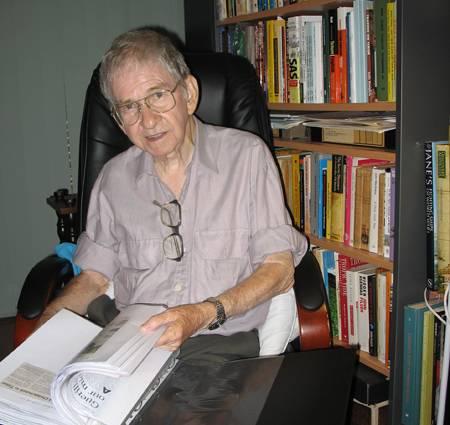
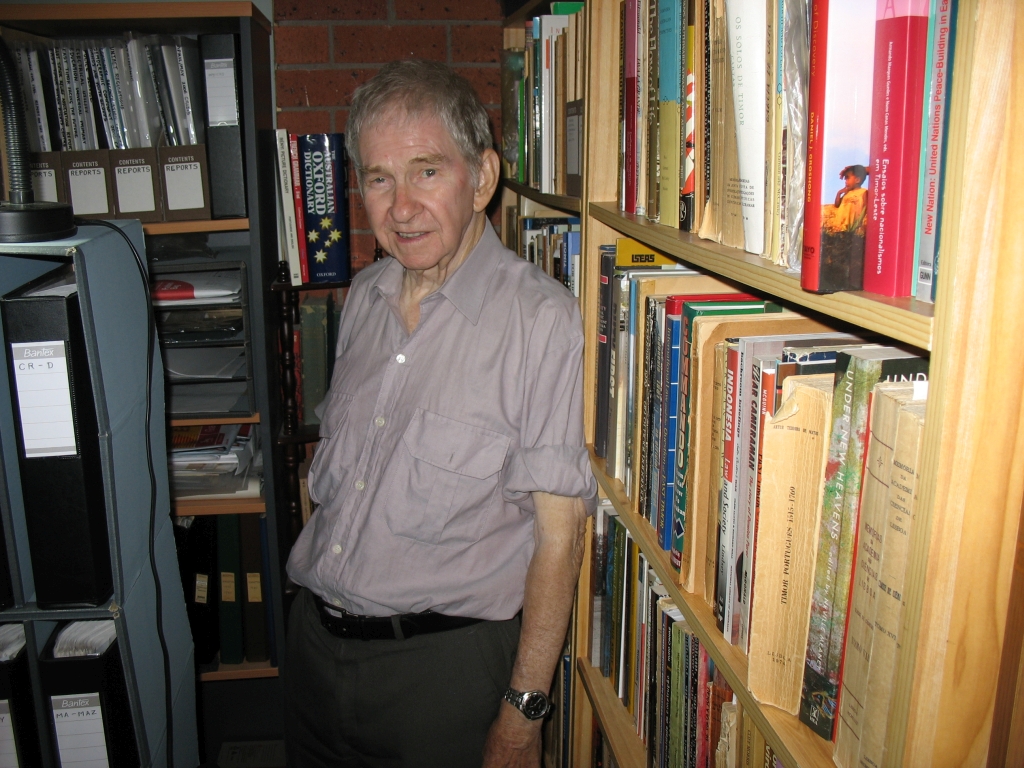
Kevin Sherlock at home. June 2011

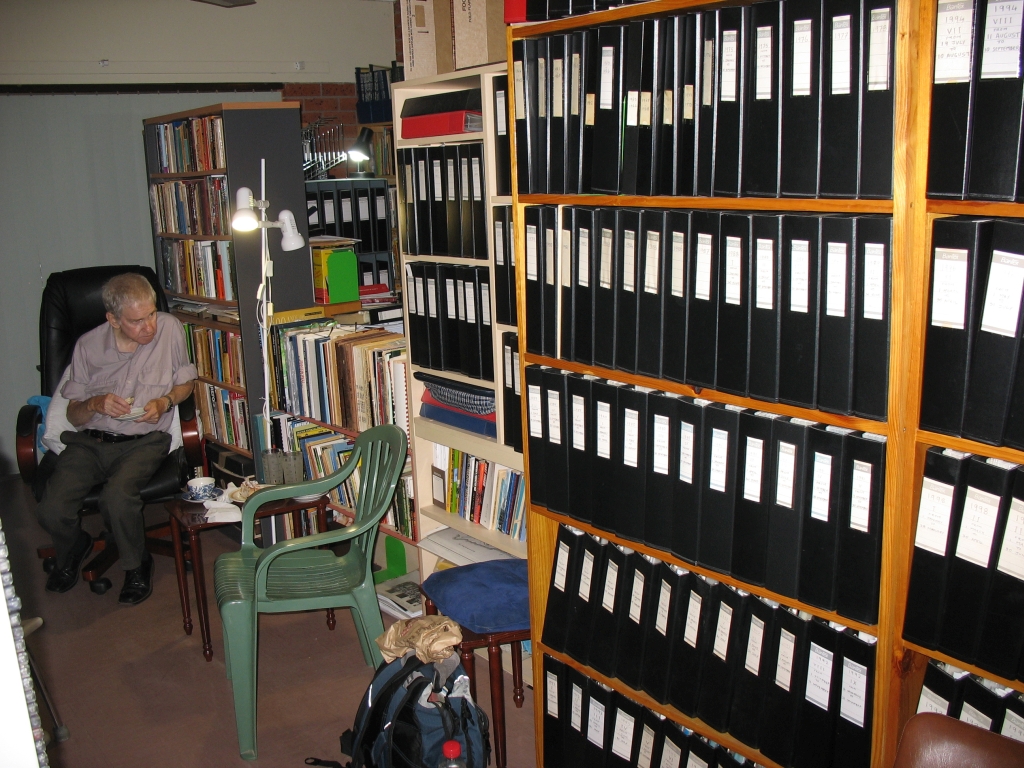
Somewhere off to the side is a kitchen and bedroom, but in this living room are tightly packed shelves of scrupulously well-ordered folders and books. This is the Darwin home of Kevin Sherlock – legendary bibliographer and collector of Timor literature.

Kevin’s living room is both library and archive and, along with its creator, a Timor research institution in its own right.  Many a Timor researcher over the past 35 years has, sooner or later, realised they should call on Kevin Sherlock’s encyclopaedic knowledge and collection for guidance on possible source materials for a myriad of Timor topics dating back to early Portuguese colonial times.

A question on sources causes an immediate twinkle in the eye and is soon followed by Kevin heading off to one or more bookshelves for an answer.  From the outset of his mission to find and collect Timor literature, Kevin has generously shared the fruits of his knowledge with all comers.

In May 2010, the State of Timor-Leste formally honoured Kevin Sherlock for his work.

The collection

In addition to an ever-increasing collection of early and recent published monographs, Kevin’s collection includes huge numbers of colonial and post-colonial official papers, serials, published articles and news media reports.

Not content with simply collecting, Kevin has indexed people and place names in un-indexed publications. He has compiled from multiple sources useful research lists such as the Portuguese governors and traditional rulers in colonial Timor.

With Kevin’s permission, we make available here his 448-page 2002 Shelf List. While in need of updating (in progress), this list provides an detailed guide to his collection contents.

Beginnings

Kevin Sherlock’s work on Timor literature began by chance after a two-week holiday in Timor in 1974.  He began to search for Timor literature to inform his planned return holiday in 1975. His first list of sources was later seen by Jose Ramos-Horta and others who encouraged him to expand his work. The rest is history…

Employed in stationery businesses, Kevin then spent much of his holidays and spare time, along with extensive periods of unpaid leave,  finding, documenting and collecting. Retirement as an aged pensioner in 1999 meant less monetary resources for his work, but the freedom to spend most of his waking hours documenting his materials and selflessly assisting many researchers who came to his door.

A detailed account of his work, including a guide to some of the research resource material he has created, can be found here.

The future

The question of what might become of Kevin’s collection for the longer term has been settled. Kevin has willed his collection to the Library of Charles Darwin University in Australia’s Northern Territory. There it will complement another significant Timor collection purchased from Portugal some years ago.

A small fragment of this latter collection has been digitised and is accessible online through the Library’s Arafura Digital Archive (AraDA).

Making contact

Despite physical frailty arising from serious illness in recent years, Kevin continues to welcome inquiries for guidance on research source materials.

Kevin has (unfortunately for us; perhaps fortunately for himself)  resisted the internet/email world, so his preferred contact method is to write to:
[Detail removed 30 March 2015. JW]

If the matter is urgent, you can ring Kevin; preferably late morning to late evening, Darwin time:
[Detail removed 30 March 2015. JW]

Kevin doesn’t charge for his help, but a donation towards his costs and ongoing collecting work is strongly recommended by Timor Archives.


kps2011_3526

kps2011_3522


1992 Xanana capture: Indonesian records

23 May 2011

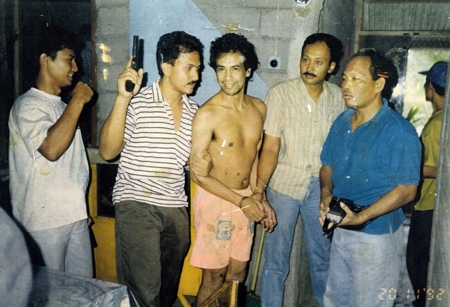
Xanana Gusmao moments after his capture. Dili, 20 November 1992

Indonesian video footage of the 1992 capture of East Timorese resistance leader Xanana Gusmao is the tip of an iceberg of still-secret Indonesian records about its military invasion and occupation of East Timor.

Aired on Australia’s Special Broadcasting Service program, Dateline, on 22 May 2011, the footage shows Indonesian preparations for the raid on a house in Dili where Xanana was known to be hiding, the armed raid and arrest and parts of a later exchange between Xanana and the head of the Indonesian military, General Try Sutrisno, who flew to Dili on news of the capture. The footage also shows Xanana’s belongings – including weapons and documents.

Questions arising
Several obvious questions arise from viewing this footage: What was the origin of the footage used by SBS and is other material available from that source; will this material be made available to East Timorese institutions for long-term preservation and access; given the relatively poor quality of the footage, does a better master exist; are the documents and weapons captured with Xanana still kept in Indonesia and if so, will they ever be repatriated to East Timor?

Xanana interrogation in Bali – more detail
A further pointer to Indonesian records of the Xanana capture can be found in a 2007 account of Xanana’s interrogation in Bali just days after his arrest in Dili.

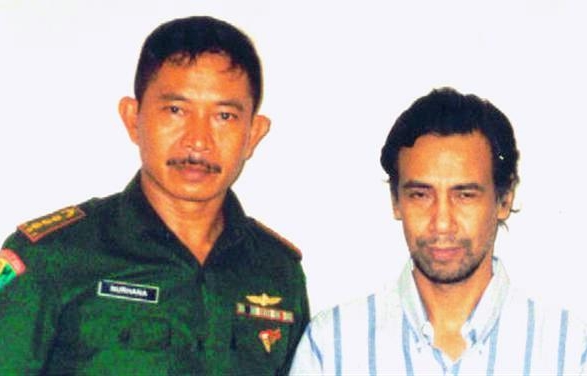
Xanana with his interrogator, Lieut-Col. Nurhana, Bali, 1992

Nurhana Tirtaamijaya, an Indonesian military police commander in 1992 and Xanana’s principal interrogator, published in 2007 a personal account of his encounters with the prized political prisoner. Pak Nurhana’s account, while emphasising his claimed ‘victory’ over Xanana, also gives some insight into the sequence of events between the resistance leader’s arrest and his incarceration in Cipinang Prison.

Australian researcher Ernie Chamberlain has translated the Nurhana text. A small selection of images from the interrogation, including captions identifying participants, can be found on Nurhana’s website (scroll through images). See also:
Xanana & Nurhana : Xanana writing : Xanana with laughing interrogators : Xanana laughing

Tapping into Indonesian records
Pak Nurhana says the story he tells was once a State top secret. Hopefully, his preparedness to tell his story publicly means other knowledgeable Indonesians may be prepared to also release their Timor information.

The task of seeking, finding and securing primary records of Indonesia’s East Timor history is large and urgent. We hope this task will be taken up by the people who can best do this – interested and concerned Indonesians.

Sources
Thanks to Ernie Chamberlain for drawing my attention to the Nurhana article and, especially, for his translation.

Thanks to Sara Niner for the use of her Xanana capture image – taken from her blog item on the topic.

Nurhana Tirtaamijaya website


Australian Archives: Access to ‘secret’ materials

29 March 2011

Australia’s Administrative Appeals Tribunal (AAT) has allowed the partial release of previously secret Timor materials held by the National Archives of Australia (NAA).

This 28 March 2011 decision appears to confirm what many researchers believe – that restrictions on access to some NAA-held materials are unwarranted.

Researchers of modern Timor history will welcome this release of hitherto restricted materials from the resource-rich National Archives of Australia. They will also wonder what secrets remain hidden in this and other archives and will continue to question the validity of some reasons for the secrecy.

Clinton Fernandes versus NAA
In 2007, former army intelligence officer and now very active Timor researcher, academic and author Clinton Fernandes sought access to NAA-held records from Australia’s Joint Intelligence Organisation (JIO; now called the Defence Intelligence Organisation). The request, while initially broad, focussed on late-1975 post-civil war reports on developments inside East Timor, covering pre-invasion Indonesian military interventions and the killing of journalists at Balibo.

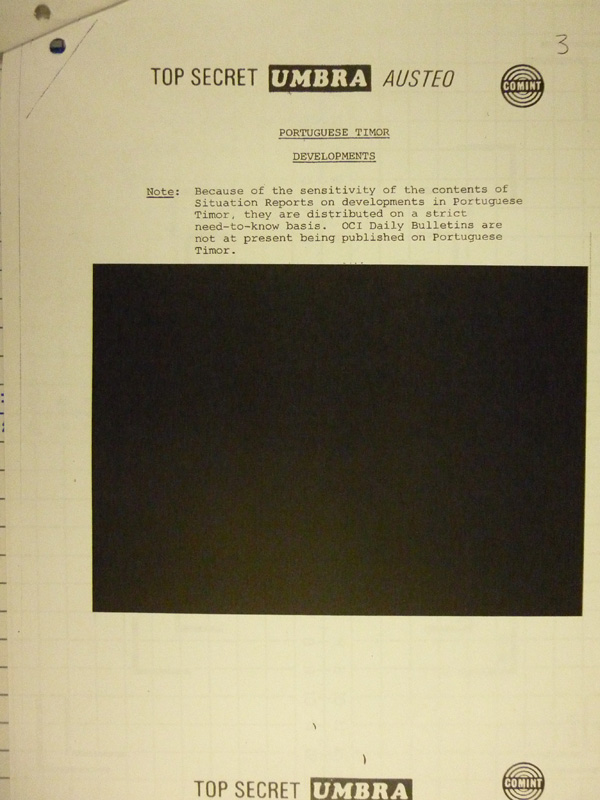
Redacted page released to Clinton Fernandes

Following what AAT President, Justice Downes, described as “significant and unfortunate” delays, Fernandes sought in late 2009 a ruling on what appeared to be a virtual denial of access by NAA. After further delays, NAA released 42 documents to Fernandes, each of which had sections ‘redacted’ (blacked out).

Fernandes appealed against the redacting of the released documents. The AAT decided, after a number of (largely closed) sessions, that 64 redacted passages across 25 documents should no longer be kept secret.

Reasons for secrecy
Australian law requires that some government archival material be kept secret beyond the standard 30-year “closed period”.*

In the case of foreign affairs and defence matters, items which are exempt from release are those which could cause damage to Australia’s security, defence or international relations. The AAT decided that “much of the material” originally redacted on these grounds should remain secret but that a number of passages could be released.

Another reason for witholding access is if the materials were received in confidence from a foreign government or international organisation. The AAT decided on these grounds that redactions made on two pages of each of three documents should remain secret.

The JIO Timor documents
A list of the 42 documents in question and the access decisions on each of them can be found in the full text of the AAT decision.

A larger list of 115 documents in the same series of JIO documents on Timor can be found on NAA’s RecordSearch facility. [Click on the number 115 under Items in this series to see the list]. None of these items have yet been digitised by NAA for public online access.

We hope Clinton Fernandes or others with easy access to the Canberra-held materials at NAA will eventually do a critical analysis of the released texts and what it reveals about the original decisions to deny access.

* The closed period was recently changed to 20 years but will be phased in over the next decade. See earlier Timor Archives article on this change.

———–

SEE ALSO:
1. Lively comment on the decision on the Open and Shut blog.

2. Clinton Fernandes interview on ABC Radio’s National Interest programme, 8 April 2011

3. Clinton Fernandes analysis of released materials. New Matilda, 14 April 2011.