Invasion 1975 – Photographs

29 April 2010

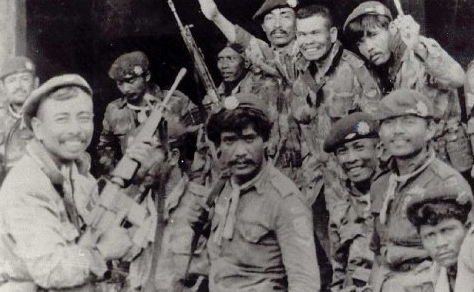
Indonesian soldiers inside East Timor, 1975

The smiles of these Indonesian soldiers inside East Timor in late 1975 belie their deadly mission. Under orders from their President (Suharto) and military superiors, they were part of the first wave of Indonesian forces launched to stifle the establishment of an independent East Timor. Many such soldiers didn’t return home. Countless numbers of Timorese died or were brutalised at their hands.

Photographs of the Indonesian military presence inside Timor in the first years of the invasion are rare. This image is one of 52 pictures posted on Facebook in mid-2009 by an East Timorese.

The images, while generally of low quality, are a valuable addition to the pictorial record of the early occupation years. Along with photographs of Indonesian troops, equipment and some senior Indonesian officers, there are also some  rare images of UDT/Apodeti forces and key personalities – presumably in the 1975 post-civil war period.

To make all these images more visible outside the Facebook community, we have created a public album – Indonesian Invasion 1975.

Where do they come from?

Our source got the digital versions from friends at an East Timorese NGO but suspects they may also not know about the origins of the set.

A small subset (11) of these images does appear on the website of the Timorese Resistance Archive & Museum (AMRT).

In addition to some more detailed captions on content of the images, AMRT attributes their origin to the collection of Mario Carrascalao (formerly Indonesian-appointed governor of Timor-Timur and now vice prime-minister of Timor-Leste). Given the varied nature of the images, it is probable Sr. Carrascalao was a collector rather than the original photographer.

It is unclear whether AMRT holds copies of all 52 images shown here, or just the ones displayed on its website (see images among those under the heading “09.01. Invasão” ).

Some of the images appear to be professionally composed. Perhaps they were originally taken by Indonesian reporters like Hendro Subroto who were ’embedded’ with Indonesian forces before and after the invasion.

How you can help

A key aim of the Timor Archives project is to connect the creators/photographers to images swirling around the internet, to get more information on them and to establish any copyright claims. Timor Archives readers can help us establish more data about these images. The obvious questions are:

  • Who took the photographs?
  • When and where were they taken?
  • Can we identify faces and locations in some of the images?
  • Who holds original or better copies?
  • Does anyone claim legal copyright?

If you can help with answers to any of these questions, please send comments through the Leave a reply/comment link immediately below or add comments to individual images in the Album.

Note on captions: Many image captions in the album may need correction. They are reproduced from the Facebook album as found and supplemented with AMRT captions where available. Comments in [square brackets] are mine.


Portuguese Timor Archives Online

14 April 2010

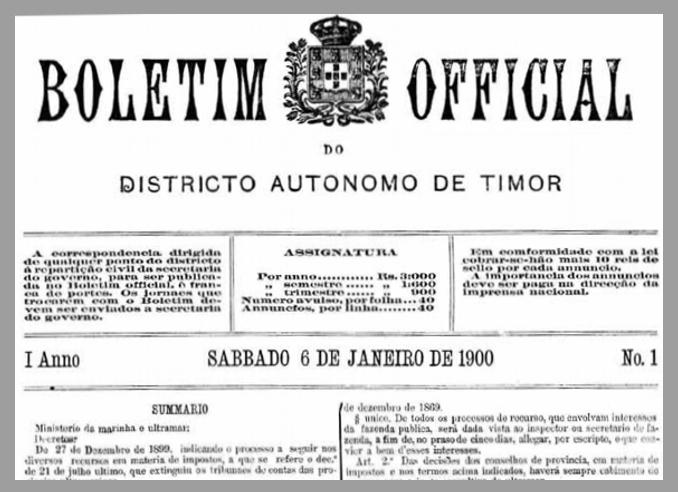
Front Page 06 Jan 1900

Portugal’s Tropical Research Institute (IICT – Instituto de Investigação Científica Tropical) offers a surprising and welcome entry point into some records from East Timor’s long Portuguese colonial era.

In the Historical Archive section of the IICT website is a link to an online version of the colonial government’s official gazette (Boletim Oficial) for Timor.

The record begins in the 1838 (when Timor was managed from Macao) and ends on 5 July 1975 (a month before the civil war). The gazette reproduces relevant official statements from Lisbon, along with local colonial administrative directives, reports, statistics, civil servant appointments etc.

While items are largely brief and predictably bureaucratic in tone, the gazette as a whole offers a ready means to track the main political/administrative developments affecting Timor over that whole period.

1912 Revolt & 1974-75 decolonisation

During 1912, the final year of the great Manufahi/Boaventura uprising, the weekly publication contained many ‘military command’ reports from the regions, headed by notes on Politica Indigena. A report on a battle at Mt Cablac and a special brief statement on a major (perhaps final?) assault on a mountain stronghold at ‘Leolaco’ (10-11 August 1912) are rare examples of specific detail on the uprising.

For the years 1974-75, a random perusal of the gazette appears to show little of the drama and detail of what East Timorese were doing and thinking in Timor. The publication is, however, a very useful guide to Lisbon’s directives on Timor after the Carnation Revolution and, for example, includes the ground rules for the establishment of a formal decolonisation commission for Timor (April 1975).

Limitations

Welcome as this resource is, there is room for improving its presentation. The search screen is limited to finding a particular issue (by date) and navigation within a given issue is limited to viewing page by page (which does become tedious). Some of the digitised pages are very difficult to read; many will be too faint for any future OCR process (Optical Character Recognition – which would allow text searching within the collection). For the future perhaps – create a rough index by rescanning the content-summary front pages of the gazettes and converting them to searchable text?

films

Films: 1950s Timorese culture

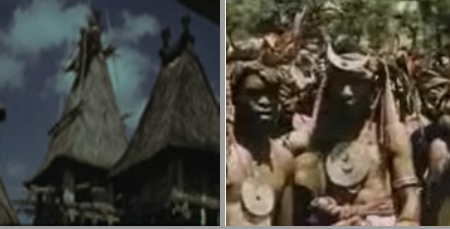
Also on the IICT website are short extracts of 23 films (16mm) taken in Timor during the 1953-54 anthropological mission headed by António de Almeida.

In addition to moving images of indigenous Timorese arts, crafts, building and cultural performance in various regions, the samples also include several (somewhat upbeat) sequences on Portuguese colonial reconstruction after World War II.

Links to this set of film samples can be found here.

———

Can you help?

I intend constructing a guide to other East Timor archival resources in Portugal – online or not. I would be grateful for any information on, or guides to, known public or private materials which I could include in the Collections section of this website.

——–

Credits: Thanks to Susana Barnes (and her original informant) for drawing my attention to the 1950s film records and to Kevin Sherlock for background information on the Gazette.


SBY’s Timor History

12 March 2010

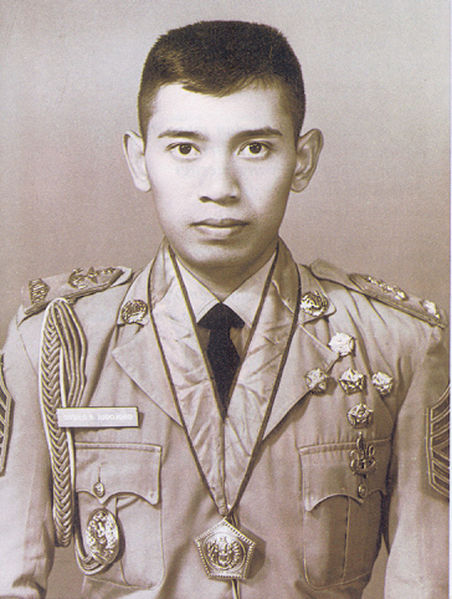
SBY - top graduate 1973

Indonesian President Susilo Bambang Yudhoyono (SBY), like many of his generation of former military men, has a Timor history. Australian researcher Ernie Chamberlain shows that, while SBY may not have been in the very first wave of the 7 December 1975 Indonesian military invasion, he was on active duty in Timor in those early years of the occupation which had such catastrophic consequences for the Timorese population and resistance. While the detailed story of SBY’s roles inside Timor is yet to be told, what follows sketches the beginning of his Timor history.

Chamberlain writes:

In his senior year (1973) at the Akabri military academy at Magelang, Bambang Yudhoyono was the Dandivkortar (“top cadet”) – overseeing 3,000 cadets. On graduation in November 1973, as the “top student” among the 987 graduates (Prabowo Subianto, by the way, graduated the following year in third place), he was presented with the Bintang Adhi Makayasa medal personally by then President Soeharto.
From Akabri, he was posted as a platoon commander to Kostrad’s 330 Airborne/Raider Battalion (Commander 3 Platoon, “A” Company) serving in the period “1974-76”. That unit’s history website notes that the battalion saw service in Timor in “1975-1976″.
Indonesian journalist and author Hendro Subroto has written on 330 Battalion’s operations in several of his works. In particular, two battalions of 330 Battalion’s formation – the 17th Airborne Brigade/”Satgas B” – parachuted onto the Baucau airfield on 10 December 1975, but 330 Battalion (commanded by Major Syukur) did not arrive in Baucau from Kupang until 14 December in an airlanded operation utilising civil-type aircraft. Soon after landing, 330 Battalion led the ABRI advance south to Viqueque – meeting quite stiff Falintil opposition led by Sabika in the Lariguto/Ossu area.

SBY’s Timor entrance
But was Yudhoyono with 330 Battalion in Timor in December 1975 ? I think not.
Firstly, Hendro Subroto is an inveterate “name dropper”. In relating operations in Timor, he invariably highlights the presence/role of any later-to-become-senior ABRI officers. He makes no mention of Susilo Bambang Yudhoyono in the Baucau/Viqueque operation of 330 Battalion. Moreover, Yudhoyono reportedly attended English language training at the US military’s Defence Language Institute in Texas in late 1975/early 1976, followed by Airborne and Ranger training at Fort Benning in 1975-1976.
He apparently returned to Indonesia in mid-1976 – deploying to Timor in August 1976 as a platoon commander in 305 Battalion (a month after his marriage to the daughter of Major General Sarwo Edhie Wibowo a renowned/infamous commander of the RPKAD and graduate of the Australian Army’s Staff College at Queenscliff, Victoria). While little is known about 305 Battalion’s activities in Timor in 1976-1977, it reportedly operated principally in Lautem.
Among his medals, Yudhoyono wears the Satya Lencana Seroja, 1976 (Operasi Seroja – Operation Lotus – was the name given to the major Indonesian military campaign in Timor from December 1975 to November 1979)

Other connections
As an aside, over the years, Bambang Yudhoyono has had several koneksi with the Australian military – and was a close friend of Lieutenant General Peter Leahy (former Chief of Army, and now a professor heading the University of Canberra’s National Security Institute). They were in the same class at the US Command and Staff College, Leavenworth in 1990-1991 (Leahy was the “top” foreign student, Bambang Yudhoyono was “No.2”). It was planned that Yudhoyono attend the year-long “one-star” ADF ACDSS course at Weston Creek (Canberra) in 1996 – but in November 1995, Yudhoyono was quite suddenly posted to Bosnia-Herzegovina as the Chief Military Observer of the UN Peacekeeping Force.

Sources:

Subroto, S., Operasi Udara di Timor Timor (Air Operations in East Timor), Pustaka Sinar Harapan, Jakarta, 2005, pp.107-197.

Wikipedia: http://en.wikipedia.org/wiki/Susilo_Bambang_Yudhoyono

Military Academy website: http://www.akmil.ac.id

Battallion 330 website: http://www.yoniflinud330.mil.id/

More SBY biographical details: http://www.tokohindonesia.com/ensiklopedi/s/susilo-b-yudhoyono/biografi/keluarga.shtml

Ernie Chamberlain is a retired Australian brigadier, having served for 36 years – including as Australian Defence Attache in Jakarta in the mid-1990s. Since retirement in 1998, he has spent some years in Timor – including advising Defence Minister Roque Rodrigues and F-FDTL commander Taur Matan Ruak on defence policy and planning (2004-05).


Oliver Strewe Photographs 1975

10 March 2010

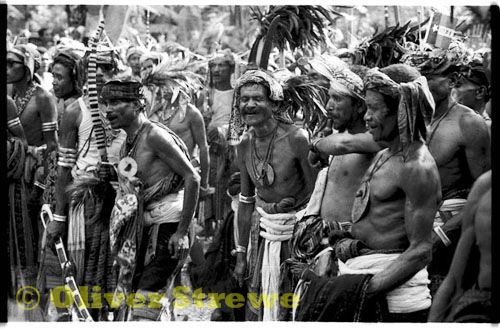
In April-May 1975, young Australian photographer Oliver Strewe visited East Timor to photograph the land, its people and the optimism and excitement engendered by the impending end of Portuguese colonial rule.

Using Jose Ramos-Horta’s living room floor as a base in Dili, Oliver travelled widely in the countryside to take historic and memorable black and white images. Many of his pictures were used in the mid-1970s in East Timor solidarity publications worldwide.

A small sample of his images from that time can be viewed in CHART’s Oliver Strewe Album .

In these internet days, it is common to see Timor images circulated widely without knowledge of, or credit to, their origins or creator. That is certainly the case with Oliver Strewe’s images as well as those of other well-known pre-invasion professional photographers like Elaine Briere, Bob Hannan and Penny Tweedie.

These images will become much more valuable in the future if we can go back to their creators and learn something from them of the circumstances of their creation along with surviving data on where and when the pictures were taken in the first place.

The aim of this post is to begin to restore the connection between Timor images and their creators. I hope to do more of this over the coming months.

Note on images

The Oliver Strewe Album images are reproduced here with Oliver’s permission. The images are of restricted size – big enough to appreciate contents, but small enough to discourage unauthorised use.

All requests for access/use of higher resolution images should be directed to info@oliverstrewe.com or see Oliver’s website.


The Two Purwantos

31 January 2010

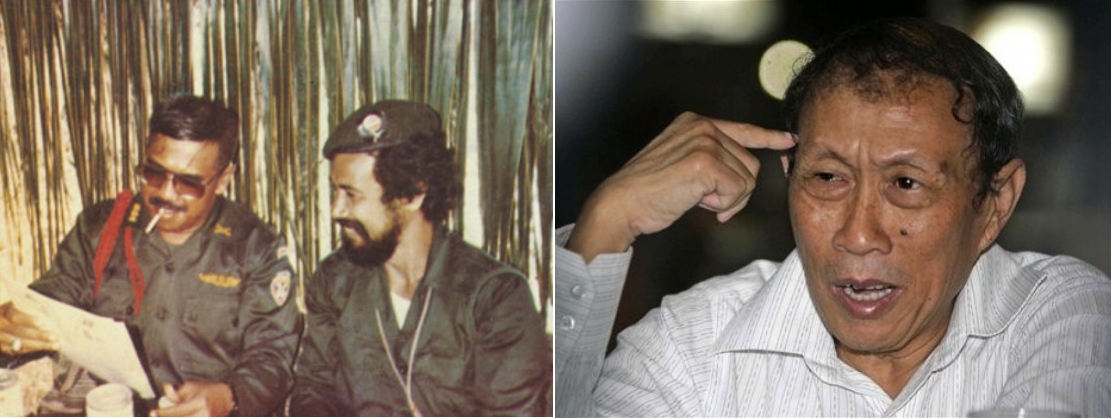
Colonel Purwanto and Xanana 1983               Gatot Purwanto, Jakarta 2009

The name Purwanto is well known in the history of Indonesia’s military occupation of East Timor. In 1983, Colonel Purwanto, then direct commander of Indonesian forces in the territory, represented Indonesia in negotiations with Xanana Gusmao, the commander of the East Timorese resistance army, Falintil.

When a retired Colonel Gatot Purwanto made international news in late 2009 admitting he was a member of the Indonesian military team responsible for killing the ‘Balibo Five’ journalists in October 1975, most assumed this was the same Colonel Purwanto of 1983 negotiations fame.

Australian researcher Ernie Chamberlain believes there are two different Purwantos – though, confusingly, both were involved in different roles in the 1983 negotiations. He writes:

‘In recent weeks, in writing about Timor, a number of contributors have confused two ABRI officers ie Colonel Purwanto (Artillery) – the East Timor commander in 1983 (ie Danrem 164/Wira Dharma) and Major Stefanus Gatot Purwanto – a senior Kopassus detachment commander in Timor in the early 1980s.

‘Major (Kopassus) Gatot Purwanto did the “leg work” in late 1982 and early 1983 in preparing the March 1983 ABRI-Falintil ceasefire talks at Lariguto – while Colonel Purwanto (Danrem 164) was the Indonesian military’s principal in the discussions with Xanana Gusmao.

‘Colonel Purwanto (Danrem 164, Artillery) – somewhat “tubby” and “moustachio-ed”, is seen in the 1983 “Lariguto photographs” with Xanana Gusmao. Major Stefanus Gatot Purwanto – as a Colonel, became the ASINTEL Kolakops/Komandan Satgas Intel in Timor Timur in 1990 – and was dismissed/pensioned from ABRI following the 1991 Santa Cruz massacre.

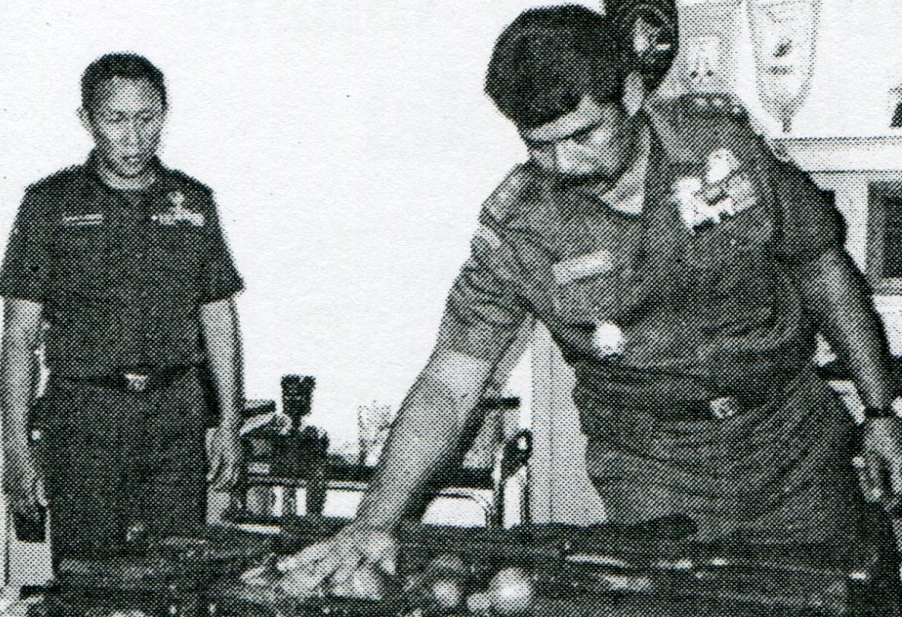
Major General Sintong Panjaitan (right) in Dili after the Santa Cruz massacre, November 1991. Figure at left almost certainly Colonel Gatot Purwanto as a senior intelligence officer

‘Interestingly, in December 2009 during his interviews related to the film “Balibo”, retired Colonel Gatot Purwanto – aged 62, claimed that at the time of the “Balibo incident” in mid-October 1975, he had only been out of AMN Magelang – the ABRI officer academy – for three years:  “I was a first lieutenant at the time, just three years out of officer training school”, he recalled.  However, according to other reports, Gatot Purwanto graduated from AMN Magelang in 1968 (the same year as Wiranto – born in 1947). Also, in Hendro Subroto’s 2009 book on the career of Major General Sintong Panjaitan, a Captain Gatot Subroto is noted as a Kopassandha intelligence officer on operations in West Kalimantan in 1973. The foregoing suggests that perhaps Colonel (Retired) Gatot Purwanto’s December 2009 statement on his seeming ‘junior status’ at Balibo in 1975 requires some further examination.’

Chamberlain Notes on Indonesian military terms:

Danrem is the Komandan Korem ie the Commander of the Military Regency/Sub-Area Command (ie Timor Timor was Korem 164 – established March 1979). “Dan” is for “Komandan” and “Rem” is for “Resort Militer“.

ASINTEL is “Assistant for Intelligence” ie a staff officer on a headquarters responsible for the intelligence function.

Kolakops is “Komando Pelaksanakan Operasi” – ie “Executive Operational Command” – ie a special operational command set up in East Timor (commanded by a brigadier) to manage tactical field operations with the Danrem 164 (a full colonel appointment) being responsible for administration and territorial operations. Kolakops was founded in Timor in 1989 and functioned until 1993 – ie disbanded following the investigation into Santa Cruz. However the operational command appears to have continued covertly from outside Timor ie with “guidance” from Kopassus Group 3 Headquarters in Batujajar, West  Java. Of course, many of the Danrem Colonels in East Timor were Kopassus officers.

Komandan is Commander; Satgas is Satuan Tugas – ie Task Unit – so Satgas Intel – is the intelligence task unit – staffed almost exclusive in East Timor by Kopassus.

Kopassus is Komando Pasukan Khusus –  Special Forces . Originally known as RPKAD – Resimen Para Komando Angkatan Darat, then changed to Kopassandha (Komando Pasukan Sandi Yudha) on 17 February 1971, before becoming Kopassus on 26 December 1986. Therefore, technically, young Lieutenant Gatot Purwanto was a member of  Kopassandha at Balibo in 1975, and also later as Major Gatot Purwanto in Kopassandha when engaged in the 1983 ceasefire machinations.

——–

Ernie Chamberlain is a retired Australian brigadier, having served for 36 years – including as Australian Defence Attache in Jakarta in the mid-1990s. Since retirement in 1998, he has spent some years in Timor – including advising Defence Minister Roque Rodrigues and F-FDTL commander Taur Matan Ruak on defence policy and planning (2004-05).

He has written several privately-published monographs including:
The Struggle in Iliomar: Resistance in rural East Timor (2003, 2004, 2008).
Faltering Steps – Independence Movements in East Timor in the 1950s and 1960s (2005).
Rebellion, Defeat and Exile: The 1959 Uprising in East Timor (2007).
Faltering Steps: Independence Movements in East Timor – 1940s to the early 1970s (2007, 2008).
He has recently completed a monograph on the Timorese who served with SRD/Z Special Unit against the Japanese in Portuguese Timor during WWII.